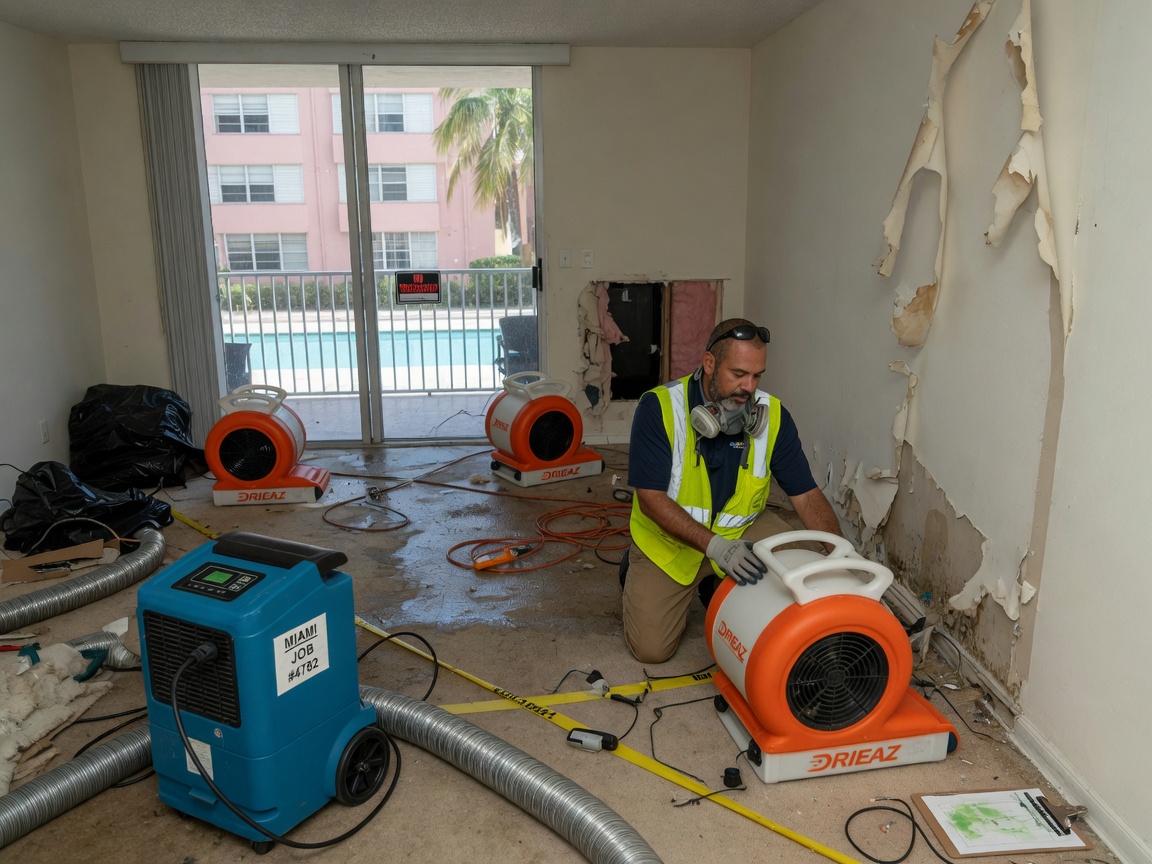
Miami's tropical monsoon climate keeps relative humidity above 70 percent for months, so structural drying after leaks or storms must pull moisture from concrete slabs, plaster walls, and older wood framing common in Little Havana and Overtown homes built before 1960. Technicians map moisture with meters and thermal cameras, then stage industrial dehumidifiers and air movers to create negative pressure that forces evaporation without spreading spores into adjacent units in Brickell high-rises. Failure to reach subfloor and wall cavities leaves residual water that fuels mold within 48 hours once summer rains resume.
In Coconut Grove and Coral Gables neighborhoods, raised homes on limestone often trap water under tile and in crawl spaces where airflow is limited. Drying crews remove baseboards, drill small vent holes, and run low-grain refrigerant dehumidifiers for several days while monitoring daily moisture readings to meet IICRC S500 guidelines. Miami-Dade County building codes require documentation of drying progress before drywall replacement, so crews log readings at multiple depths to satisfy inspectors and prevent callbacks when humidity spikes again.
Design District lofts and Downtown Miami commercial spaces frequently involve mixed materials like poured concrete, metal studs, and historic masonry that dry at different rates. Over-drying can crack plaster while under-drying leaves pockets that later cause delamination. Crews adjust equipment daily based on psychrometric readings taken on site, accounting for the fact that nearby Miami Beach salt air accelerates corrosion on HVAC components during extended drying projects.
Technician insight
In Miami the thing that catches most people out with Structural Drying is how quickly our tropical monsoon humidity re-saturates concrete slabs and plaster in pre-1960 Little Havana homes once the machines are pulled too soon.
Brickell Loft After Pipe Burst
A second-floor unit in a 2008 Brickell building suffered a supply line failure that soaked engineered flooring and the concrete slab below. Moisture readings showed water had wicked into adjacent unit walls. Crews ran dehumidifiers and air movers for six days while logging daily readings until slab moisture dropped below 12 percent. The space passed inspection and was cleared for new flooring without mold growth.
Structural Drying Services We Offer
✓Moisture Mapping and Assessment
Pinpoint hidden water in slabs, walls, and ceilings using meters and thermal imaging before equipment placement in Miami-Dade structures.
✓Industrial Dehumidification
Deploy low-grain refrigerant units sized for Miami's high humidity to pull moisture from porous materials without overloading electrical panels.
✓Air Mover and Fan Placement
Position high-velocity air movers to create directed airflow across wet surfaces in older Wynwood and Little Havana homes.
✓Crawl Space and Subfloor Drying
Extract trapped moisture from under raised homes in Coconut Grove and Coral Gables where limestone terrain limits natural drainage.
✓Daily Moisture Monitoring
Record readings at multiple depths to document drying progress and satisfy Miami-Dade County inspection requirements.
Structural Drying Cost in Miami, FL
| Service | Typical Range | What Affects It |
|---|---|---|
| Single room drying | $600–$1,200 | Varies with wall and floor materials plus daily humidity levels |
| Whole-home drying | $2,000–$4,500 | Depends on number of affected levels and access to subfloors |
| Crawl space drying | $800–$1,800 | Influenced by access points and standing water depth |
| Commercial space drying | $1,500–$5,000 | Scaled by square footage and mixed material types |
Ranges are typical for Miami, FL and confirmed with an exact written quote before any work starts.
How it works
- 1
Site Assessment
Technicians inspect affected areas in the property, measure moisture levels, and identify materials that will require extended drying time.
- 2
Equipment Setup
Dehumidifiers, air movers, and containment barriers are positioned to maximize evaporation while protecting unaffected rooms.
- 3
Ongoing Monitoring
Daily readings guide adjustments to equipment until moisture content returns to normal levels for the building materials.
- 4
Final Verification
Final moisture logs are provided and the space is cleared for repairs once readings meet industry standards.
Pricing
Upfront quotes based on square footage, materials, and duration; no hidden fees after initial assessment.