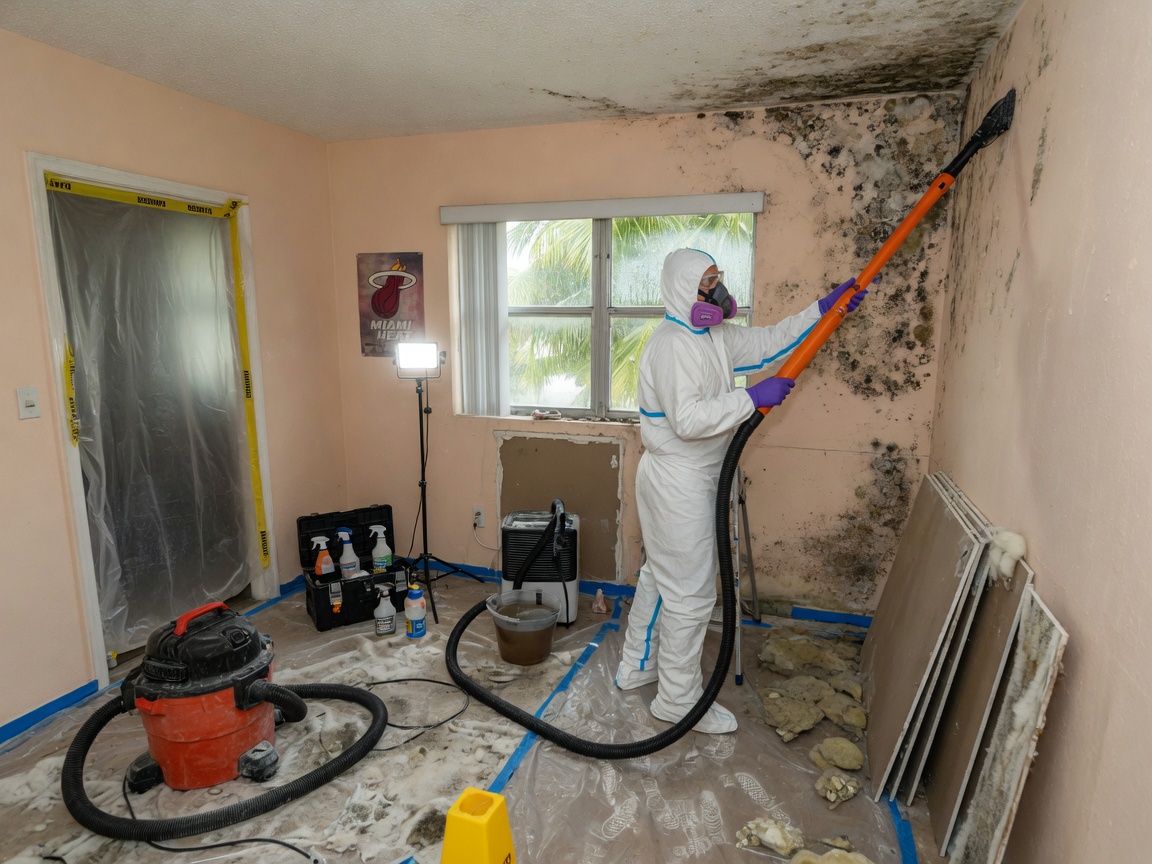
Miami’s tropical monsoon climate drives rapid mold growth once water enters a structure. Older concrete and masonry homes in Little Havana and Overtown often hide moisture behind stucco or tile, while Brickell high-rises trap humidity in HVAC returns and wall cavities. Technicians must map moisture with meters and thermal imaging before any demolition to avoid spreading spores through shared ventilation.
Miami-Dade County building codes require containment and negative air pressure for visible growth over ten square feet. Porous materials such as drywall, carpet pad, and particleboard are removed when moisture content exceeds twenty percent; non-porous surfaces receive EPA-registered antimicrobials followed by HEPA vacuuming. Post-remediation clearance testing confirms spore counts match outdoor baselines before reconstruction begins.
Summer afternoon storms frequently overwhelm window seals and roof drains in Coconut Grove and Design District townhomes. When water sits against slab foundations, mold travels upward into baseboards and cabinetry. Extraction teams use air movers and dehumidifiers sized for Miami’s dew points rather than standard residential units to reach drying goals within forty-eight hours.
Homeowners in Hialeah and Coral Gables sometimes attempt bleach cleaning on visible spots while leaving hidden growth in attics or behind shower pans. This allows colonies to return within weeks once humidity spikes again. Proper remediation includes source identification, removal of affected materials, and installation of moisture barriers or improved ventilation to match the local climate.
Technician insight
In Miami the thing that catches most people out with Mold Remediation is how fast spores take hold behind tile in 1960s-70s concrete block homes once a small leak hits during summer rains; the slab never dries on its own in our humidity and the growth travels up the wall before anyone notices.
Hidden growth behind shower in Coral Gables
A homeowner noticed a musty smell after a slow drain leak. Inspection found elevated moisture in the concrete block wall and mold behind the original tile. Containment was set, affected drywall and insulation removed, the cavity dried, and a moisture barrier added before new tile installation.
Mold Remediation Services We Offer
✓Black Mold Removal
Full containment and removal of Stachybotrys in bathrooms and laundry rooms common after pipe leaks in older Miami-Dade homes.
✓Attic Mold Remediation
Inspection and treatment of mold caused by roof leaks or poor ventilation in Wynwood and Overtown single-family houses during wet season.
✓Bathroom Mold Treatment
Targeted removal behind tile and vanities where constant humidity from showers meets Miami’s high dew points.
✓Crawl Space Mold Cleanup
Drying and encapsulation of mold growth under elevated homes in Coconut Grove after flooding or groundwater intrusion.
✓HVAC Mold Remediation
Duct cleaning and coil treatment to stop mold circulation in Brickell and Downtown Miami high-rise units.
Mold Remediation Cost in Miami, FL
| Service | Typical Range | What Affects It |
|---|---|---|
| Initial inspection and moisture mapping | $250–$450 | Larger multi-story homes in Coral Gables or Brickell increase time on site. |
| Small bathroom containment and removal | $800–$1,600 | Depends on square footage and whether tile must be removed. |
| Attic remediation | $1,200–$2,800 | Varies with insulation type and accessibility in older Overtown or Wynwood homes. |
| Crawl space encapsulation add-on | $600–$1,400 | Includes vapor barrier installation after mold cleanup. |
Ranges are typical for Miami, FL and confirmed with an exact written quote before any work starts.
How it works
- 1
Moisture Mapping
Technicians use meters and infrared cameras to locate hidden water in walls, ceilings, and slabs throughout the affected Miami property.
- 2
Containment Setup
Plastic barriers and negative air machines isolate the work zone to prevent spore migration into unaffected rooms.
- 3
Material Removal
Saturated drywall, insulation, and trim are cut out and bagged for disposal while non-porous surfaces receive antimicrobial application.
- 4
Drying and Clearance
Industrial dehumidifiers and air movers run until readings meet industry standards, followed by third-party air sampling.
Pricing
Quotes are provided after inspection because mold extent and access vary widely by property age and construction type.